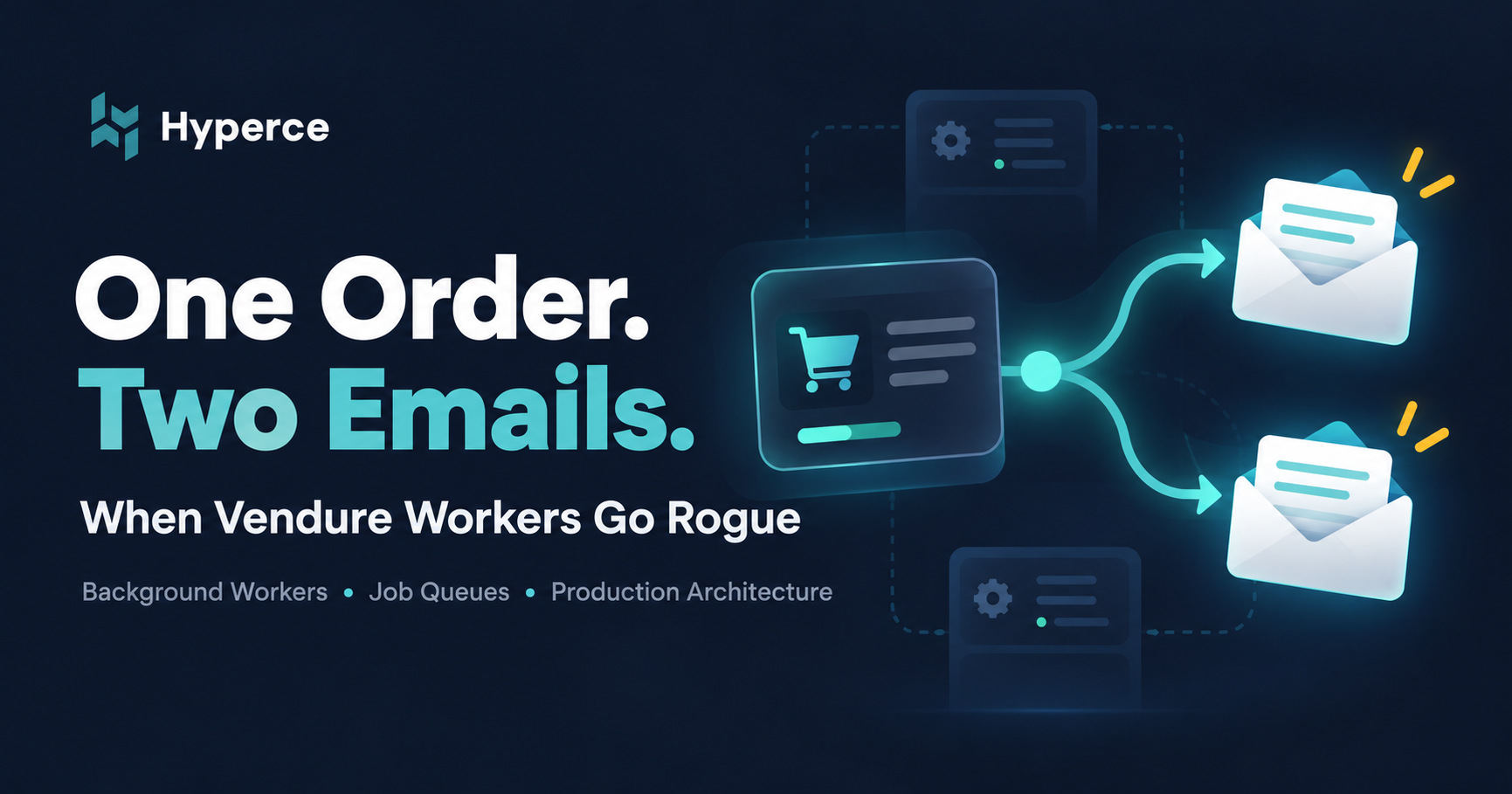
Everything can look perfect in development.
One server.
One worker.
One order.
One confirmation email.
Then production traffic arrives.
Now you have multiple worker processes running in parallel, background jobs firing at the same time, retries happening, integrations talking to each other, and suddenly something simple becomes a lot less simple.
A classic example?
Customers start receiving duplicate order confirmation emails.
Some may even receive none at all.
Not exactly the kind of customer experience anyone wants.
Vendure handles a lot of background work through its job queue system. Your main server handles API requests, while workers take care of tasks happening in the background.
Things like emails, inventory updates, order processing, integrations, and other asynchronous jobs.
In development, where you might only have one worker running, everything can look flawless.
Then you move to production.
Now several workers may be running at the same time.
And that is when concurrency starts to matter.
If a background task is triggered more than once, you need to make sure the same action does not happen twice.
The fix is usually not dramatic.
For many deployments, the first step is making important jobs idempotent.
That sounds technical, but the idea is simple.
Before performing an action, check whether it has already happened.
Before sending an order confirmation, check whether the confirmation has already been sent.
Before updating inventory, make sure the same adjustment has not already been processed.
Before triggering another workflow, make sure the system is not repeating something it already completed.
One small check can prevent a surprisingly large production headache.
For more serious deployments, the job queue architecture matters too.
As stores grow and more workers are introduced, teams may move toward queue systems designed for distributed workloads, stronger locking, retries, and more reliable processing across multiple worker instances.
The exact setup depends on the size of the system, the workload, and how much traffic the store is handling.
But the lesson stays the same.
Development behavior is not always production behavior.
And this is one of the things we like about Vendure.
It gives developers a very strong foundation to build on.
TypeScript-first architecture.
Powerful APIs.
Flexible plugins.
Custom workflows.
Background workers.
Admin tools.
A lot of difficult commerce logic is already handled.
But like any serious commerce platform, you still need to understand the moving parts.
What happens when two workers run at the same time?
What happens when a job fails and retries?
What happens when a payment provider sends the same webhook twice?
What happens when inventory changes while several customers are checking out?
What happens when traffic suddenly increases?
These are the things that usually do not show up while building the first version of a store.
They show up later.
Usually when real customers are already using it.
That is why production architecture matters.
At Hyperce, we work with Vendure beyond simply getting a store online.
We think about the parts that become important once the system starts operating in the real world.
Queues.
Workers.
Retries.
Integrations.
Scaling.
Monitoring.
Commerce workflows.
And all the small edge cases that can turn into very visible customer problems if they are ignored.
Because getting an e-commerce platform running is one thing.
Making sure it keeps running properly when real orders, real payments, and real customers start flowing through it is another.
Vendure is genuinely one of the strongest foundations for building modern commerce systems.
You just need to understand how the pieces behave before production decides to teach you the hard way. And sometimes, that lesson starts with a customer receiving the same email twice.
Building with Vendure?
Hyperce helps businesses design, build, and scale production-ready commerce systems around Vendure.